MOTION/TWB-BP-0001
The Kingfisher and the Bullet Train
How a small blue bird taught Japan's fastest train to stop firing a cannon
Independently checked - curatorial review pending

Cross a hard boundary by ramping the pressure change, not cliff-ing it.
The problem
Japan built the fastest train in the world, and then it started firing a cannon.
Not a real cannon - but that is what it sounded like. Every time an early bullet train punched into a tunnel at full speed, it shoved a wall of air ahead of it. That air had nowhere to go. It compressed, raced down the tunnel, and burst out the far end as a thunderclap loud enough to rattle windows and wake up entire neighbourhoods hundreds of metres away.
The engineers had a machine that could go faster. The physics said no. The neighbours said louder no.
The answer did not come from a wind tunnel or a supercomputer. It came from a birdwatcher watching a small blue bird do the one thing his train could not: cross a hard boundary between two worlds without making a sound.
The organism
The common kingfisher (Alcedo atthis).
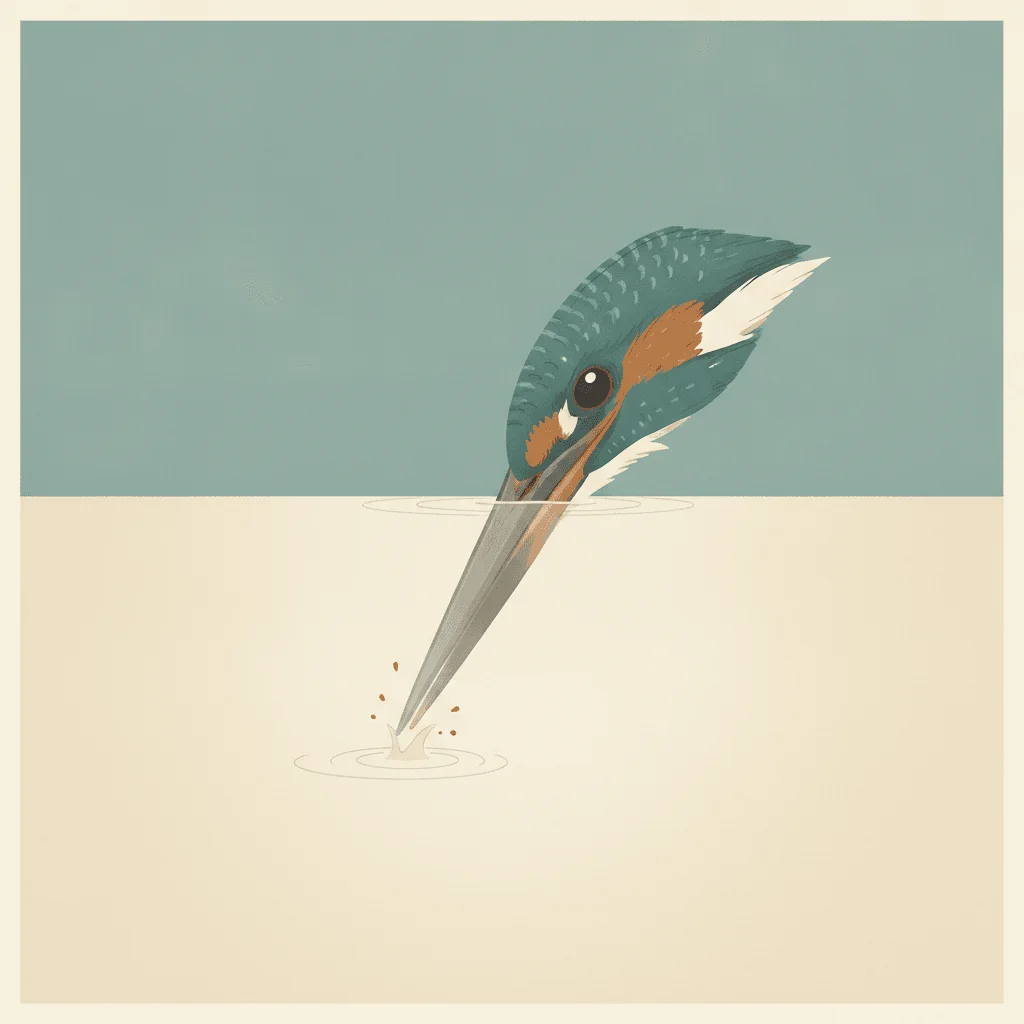
A kingfisher hunts by sitting still, then dropping like a thrown knife from open air straight into water. Think about what that actually is: it goes from a thin medium (air) into a medium roughly 800 times denser (water) in a fraction of a second - and it does it with almost no splash.
That "almost no splash" is not a nice detail. It is the whole trick. A splash is wasted energy and, worse for a hunter, a warning. A big splash sends a pressure pulse and a flash of movement through the water ahead of the bird, and the fish it is aiming at bolts before the beak arrives. The kingfishers that entered the water cleanly ate. The ones that belly-flopped went hungry. Over deep evolutionary time, that pressure selected for one specific shape: a long, tapered, wedge-like beak with a smoothly widening cross-section.
Remarkably, this is not a one-off. A 2019 study in the Journal of the Royal Society Interface found that drag reduction at the air-water interface has evolved repeatedly and independently across diving kingfisher species - nature converging on the same solution more than once, which is about as strong a signal as biology ever gives you that a design is right.
The mechanism
Why does a pointed, gradually-widening beak enter water so quietly?
A blunt object hitting water has to move a lot of water out of the way all at once. The water cannot get out of the way fast enough, so it piles up, folds over, and slams back - that collision is the splash, and it is a small shock wave. The sudden jump in pressure at the boundary is where the energy goes and where the noise comes from.
The kingfisher's beak does the opposite. Because it tapers, the first point of contact displaces almost no water. As the bird pushes deeper, the beak's circumference grows gradually, so at every instant only a little more water is asked to move, and it has time to slide smoothly aside instead of being punched. The pressure builds up along a ramp rather than a cliff. No sudden jump, no shock wave, no splash. Engineers call the resulting smooth, non-turbulent flow laminar flow.
Now look at the train's problem again and it is the same problem wearing a different costume. The old bullet train had a rounded, bluntish nose. Racing into a tunnel, it hit the still air the way a blunt object hits water: it could not move all that air aside fast enough, so the air compressed into a pressure wave that ran ahead and detonated at the tunnel mouth - the "tunnel boom." Open air to compressed tunnel air is the same hard boundary a kingfisher crosses going from air to water. Same physics. Same fix.
The principle
When you cross a hard boundary between two media, shape the transition so pressure builds up a ramp, not a cliff.
A blunt boundary forces a sudden pressure change, and a sudden pressure change is a shock wave - splash, boom, wasted energy, noise. A gradual, tapered geometry spreads that same change over distance, so the media have time to get out of each other's way. You do not fight the pressure with more power. You defuse it with a smoother slope.
The trick is that this principle does not care whether the two media are air-and-water or open-air-and-tunnel-air. It is portable. That is what makes it a blueprint and not just a bird fact.
The application
The Shinkansen 500-Series (JR West).
Eiji Nakatsu, the engineer leading the 500-Series programme at JR West and a keen amateur birdwatcher, made exactly this leap. In his own words, "a kingfisher dives from the air, which has low resistance, into high-resistance water, and moreover does this without splashing." His team reshaped the front of the train into a long streamlined nose modelled on the beak - about 15 metres long, near-circular in cross-section.
The measured results, again in Nakatsu's own words: air pressure reduced by about 30%, electricity use reduced by about 15%, and speed increased by about 10% over the previous series. (The 30% figure is the air-pressure reduction and the 15% is the energy figure - they are two different measurements, not one stacked number.)
The 500-Series entered passenger service in March 1997 and was the first Shinkansen to run at 300 km/h in regular service, engineered with headroom up to 320 km/h.
The boom was only half the noise. The other culprit was the pantograph - the arm on the roof that draws power from the overhead wire - which howled as air tore past it. Nakatsu went back to the birds. Owls fly almost silently because tiny saw-tooth serrations on their wing feathers break the big, noisy air vortices into smaller quiet ones. His team cut serrations into the pantograph, and it worked.
Where else the principle travels: any time a body crosses or moves fast through a fluid boundary - ship and torpedo bows, drone and aircraft noses, even quieter fan and pump inlets - the "ramp, not cliff" idea applies. The kingfisher nose is now a textbook opening move in biomimetic design.
The takeaway
When you hit a wall between two worlds, do not push harder - reshape the doorway.
The bullet train did not get quieter by adding power or padding. It got quieter by copying a shape that spends a pressure change over distance instead of all at once. If a system of yours "booms" - a spike, a shock, a hard hand-off between two states - look for the blunt boundary and taper it.
Sources
- Japan for Sustainability - "Shinkansen Technology Learned from an Owl? The story of Eiji Nakatsu" (primary interview): the kingfisher-inspired nose, ~15 m near-round cross-section, and Nakatsu's own figures (air pressure −30%, electricity −15%, speed +10%), plus the owl-serration pantograph. https://www.japanfs.org/en/news/archives/news_id027795.html
- Crandell, Howe & Falkingham, "Repeated evolution of drag reduction at the air-water interface in diving kingfishers," Journal of the Royal Society Interface 16(154), 2019. https://royalsocietypublishing.org/doi/10.1098/rsif.2019.0125
- Wikipedia - "500 Series Shinkansen" (entered service March 1997; first Shinkansen at 300 km/h in regular service; designed for 320 km/h). https://en.wikipedia.org/wiki/500_Series_Shinkansen
- AskNature - "The Beak That Inspired a Bullet Train" (gradual cross-section → progressive water displacement → laminar flow). https://asknature.org/strategy/beak-provides-streamlining/
Conservation note: the common kingfisher (Alcedo atthis) is listed Least Concern on the IUCN Red List (BirdLife International). Not every organism in this library is so lucky - and every extinction is a deleted patent.