EXCHANGE/TWB-BP-0002
The Termite Mound and the Building That Breathes
How an office block in Zimbabwe stays comfortable with almost no air-conditioning - and why the famous version of the story is half wrong
Independently checked - curatorial review pending
Regulate an internal climate with geometry and thermal mass powered by free ambient energy - instead of a machine that burns power fighting the outside.
The problem
In the middle of Harare, Zimbabwe, there is a shopping-and-office complex that refuses to sweat. Outside, the African high-veld swings from near-freezing nights to fierce afternoons. Inside the Eastgate Centre, the air stays comfortable all year - with no conventional air-conditioning plant at all. No chillers on the roof. No compressors humming through the night.
The architect, Mick Pearce, did not start with a mechanical-engineering catalogue. He started with a dirt tower built by insects - a termite mound - and a claim that had circulated for decades: that termites hold the inside of their mounds steady while the land around them lurches between extremes.
It is one of the most-repeated stories in all of biomimicry. It is also the one where nature turns out to be more interesting - and less obedient - than the legend. So we will tell it twice: the version everyone repeats, and the version the biologists actually found.
The organism
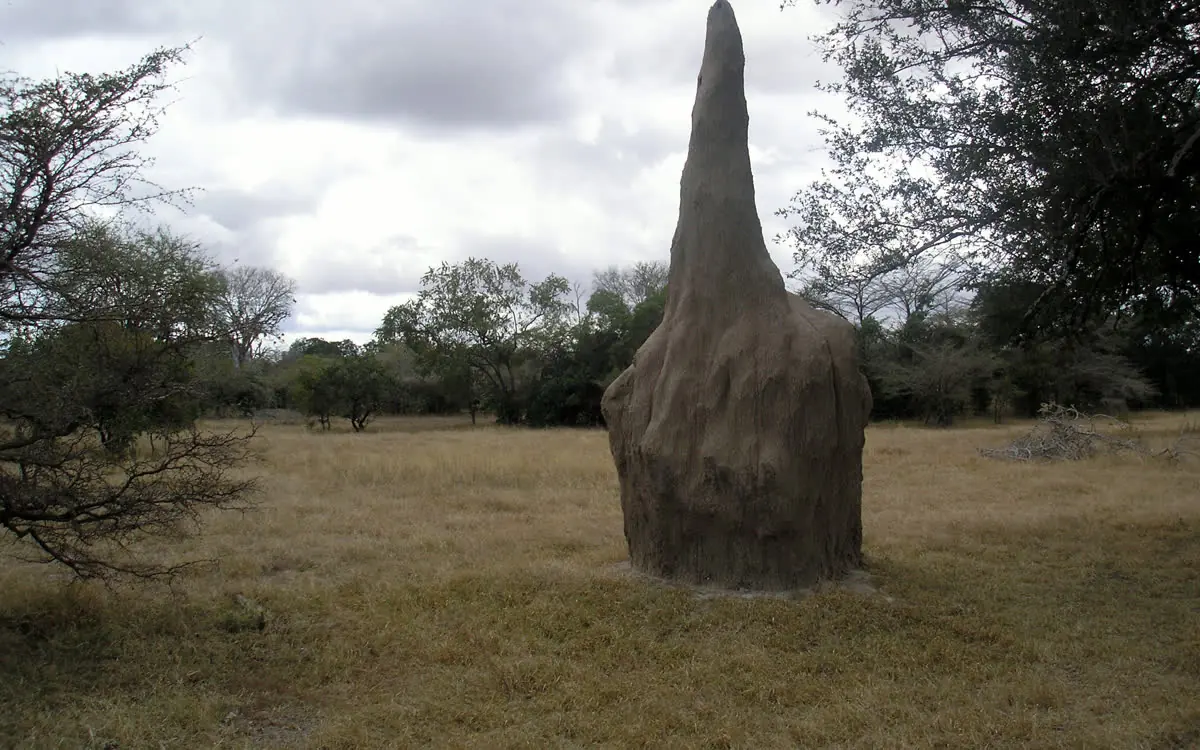
Fungus-growing termites (Macrotermes, Odontotermes and relatives).
A termite colony is not really the insects. It is the farm. These species survive by cultivating a fungus (Termitomyces) in underground gardens; the termites feed it dead plant matter, and the fungus breaks that down into food the colony can eat. The fungus is fussy - it grows best in a warm, stable band, commonly cited around 30 °C - and a big colony can run into the millions, all respiring, all giving off heat and carbon dioxide down in the nest.
So the colony has two hard problems at once. It must keep the fungus gardens in a liveable range, and it must breathe - flush the CO₂ that millions of animals and a working fungus farm pump out, and pull in fresh oxygen - without ever cutting a door to the surface that a predator or the dry air could exploit. The mound above ground - sometimes several metres tall, riddled with channels - is the machine they evolved to solve that. It has no moving parts and burns no fuel. It runs on the sun, the daily temperature swing, and the wind.
The mechanism
Here is where honesty matters, because there are really three stories, not one.
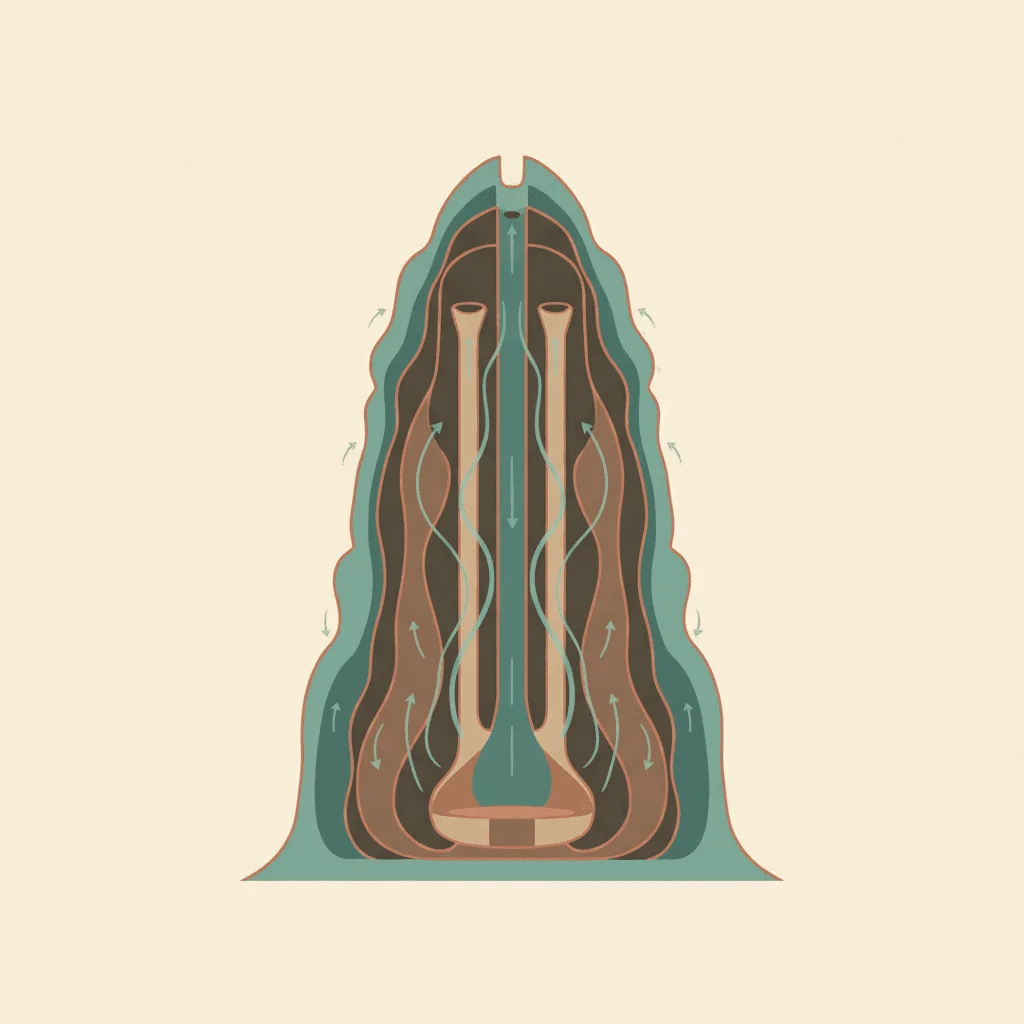
The classic story (the one in every popular article). In the late 1950s the Swiss entomologist Martin Lüscher proposed that the mound works like an air-conditioner: warm, stale air rises up a central chimney, cool fresh air is drawn in low, and a steady draft holds the nest at a constant temperature. Clean, intuitive, easy to draw - and the picture that inspired a generation of architects.
The correction (since the 1990s). The physiologist J. Scott Turner, working with Rupert Soar on African Macrotermes, went and measured it - and the tidy chimney model largely fell apart. The nest does not hold a constant temperature; it broadly tracks the surrounding soil, drifting with the seasons. And a steady updraft mostly isn't there - many mounds simply aren't tall enough to drive one. Turner's reframing: the mound is not an air-conditioner, it is closer to a lung - a structure for respiratory gas exchange, using gusts and buffeting wind to slosh air tidally in and out, the way a lung ventilates without holding your chest at a fixed temperature.
The re-correction (2015). King, Ocko and Mahadevan measured Odontotermes obesus mounds in India and found yet another driver: the thin outer flutes heat up faster than the deep central chimney during the day, setting up a convection cell that reverses twice a day as the sun rises and sets - pumped not by wind and not by the termites' metabolism, but by the daily swing in outside temperature itself.
Which is right? It is still argued, and it seems to differ by species and mound design. What all three models agree on - and what we carry forward - is this: the mound is a passive structure that regulates the colony's environment using geometry, thermal mass and porosity, driven entirely by free ambient energy. Its main job is breathing, not perfect thermostatic control. That is the honest blueprint.
The principle
Regulate an internal environment with shape and material, powered by the energy that's already free outside - instead of a machine that burns power fighting the outside.
A conventional building treats the outdoors as an enemy: it seals up and spends electricity pumping heat across the wall, against the gradient. The mound does the opposite. It is porous and shaped so that the ambient rhythms - the cool of night, the heat of day, a passing breeze - do the work of moving air and heat. Thermal mass stores the night's cool and releases it into the day; channels let the daily temperature swing pump the air; nothing plugs in.
Two portable ideas fall out, both far beyond insects. First: use free ambient energy and mass, not machinery - night cooling, daily temperature swings and wind are energy you already have. Second, and just as important: check the biology before you copy it. The most famous "lesson" from this organism was half-wrong for forty years. A principle is only worth exporting once you know what the animal is actually doing.
The application
The Eastgate Centre, Harare (architect Mick Pearce, engineers Ove Arup & Partners, completed 1996). Pearce and Arup built the whole complex as a piece of thermal machinery with almost no machinery in it. The concrete structure is deliberately heavy - high thermal mass. At night, cool outside air is pulled through it, chilling the concrete; through the hot day, that stored cool bleeds back into the offices. Air rises and is expelled through a bank of 48 brick flues at the roof, while fresh air is drawn in low - the same low-in / high-out logic as the mound.
The measured payoff: about 35% less energy than a conventionally cooled building of comparable size, and omitting a conventional air-conditioning plant saved roughly $3.5M of a ~$36M project.
The number to be careful with. You will constantly see Eastgate credited with "up to ~90% less energy." That figure is real but conditional: it is the passive-mode comparison - the building using only about 10% of what a conventional building would - not the everyday operating figure. The honest headline is ~35% in normal operation, up to ~90% in the fully passive interpretation. Don't blur them. And one more caveat: Eastgate is not purely passive - it uses low-power fans to move air on a day/night cycle, something termites never do. It is still a genuine, large win - a big commercial building kept comfortable in a harsh climate on a fraction of the usual energy - just not the fan-free miracle of the legend.
Where else the principle travels: thermal-mass "night flushing" is now standard passive-cooling practice; stack- and buoyancy-driven natural ventilation replaces fans with tall atria and flues; phase-change materials store and release heat on the daily cycle. The deeper instinct for any thermal system: before spending energy to fight a gradient, ask what free gradient - day-night, ground temperature, airflow - you could ride instead.
The takeaway
Don't fight the climate - ride its rhythms. The termite mound doesn't beat the desert with power; it uses the desert's own day-night swing, shaped by geometry and mass, to breathe and stay liveable. Copy the strategy - but copy the real biology, not the tidy legend. The most-repeated "nature lesson" here was half-wrong for decades, and the honest version is the more useful one.
Sources
- Wikipedia - "Eastgate Centre, Harare": architect, engineers, completion 1996, ~35%-less-energy and passive ~10%-of-conventional framings, ~$3.5M saving, 48 brick flues, day/night fans. https://en.wikipedia.org/wiki/Eastgate_Centre,_Harare
- King, Ocko & Mahadevan, "Termite mounds harness diurnal temperature oscillations for ventilation," PNAS 112(37):11589-11593, 2015. https://www.pnas.org/doi/10.1073/pnas.1509750112
- J. Scott Turner & Rupert Soar, as summarised in "The termite mound: a not-quite-true popular bioinspiration story," insectsdiditfirst.com, 2013 (nest tracks soil temperature; mound as a "lung"; Eastgate uses fans). https://insectsdiditfirst.com/2013/09/18/the-termite-mound-a-not-quite-true-popular-bioinspiration-story/
- Science / AAAS - "How termite mounds breathe" (overview of the ventilation debate). https://www.science.org/content/article/how-termite-mounds-breathe
- Vesala et al., "Termite mound architecture regulates nest temperature and correlates with species identities of symbiotic fungi," PeerJ 6:e6237, 2019 (Termitomyces favours ~30 °C). https://peerj.com/articles/6237/