INTERFACE/TWB-BP-0003
The Burr That Taught Us How to Look
A weed stuck to a sock became a fastener you touched today - but the real invention was a repeatable way of reading nature's finished designs
Independently checked - curatorial review pending
Many small, reversible, directional catches beat one big permanent bond - and innovation is a repeatable act of attention, not a flash of genius.
The problem
In 1941 a Swiss engineer came back from a walk in the woods covered in burrs, and instead of picking them off and cursing, he asked a question almost nobody asks: how are you doing that?
That question - asked of a weed stuck to a sock - became a fastener you have probably touched today. It is on shoes, bags, kids' clothes, the blood-pressure cuff at the clinic, the cargo straps on spacecraft. A multi-billion-dollar industry, from a plant nobody wanted.
Here is the part that matters. George de Mestral was not a genius who conjured something from thin air. He was a curious man who paid attention to an annoyance. The plant had already solved the problem - over millions of years. He noticed, stayed curious long enough to look closer, and translated what he saw. That sequence - notice, ask "how?", translate - is not luck. It is a repeatable method. This Blueprint is about that method, told through the burr that taught it to us.
The organism
Burdock (Arctium) - and specifically its burr.
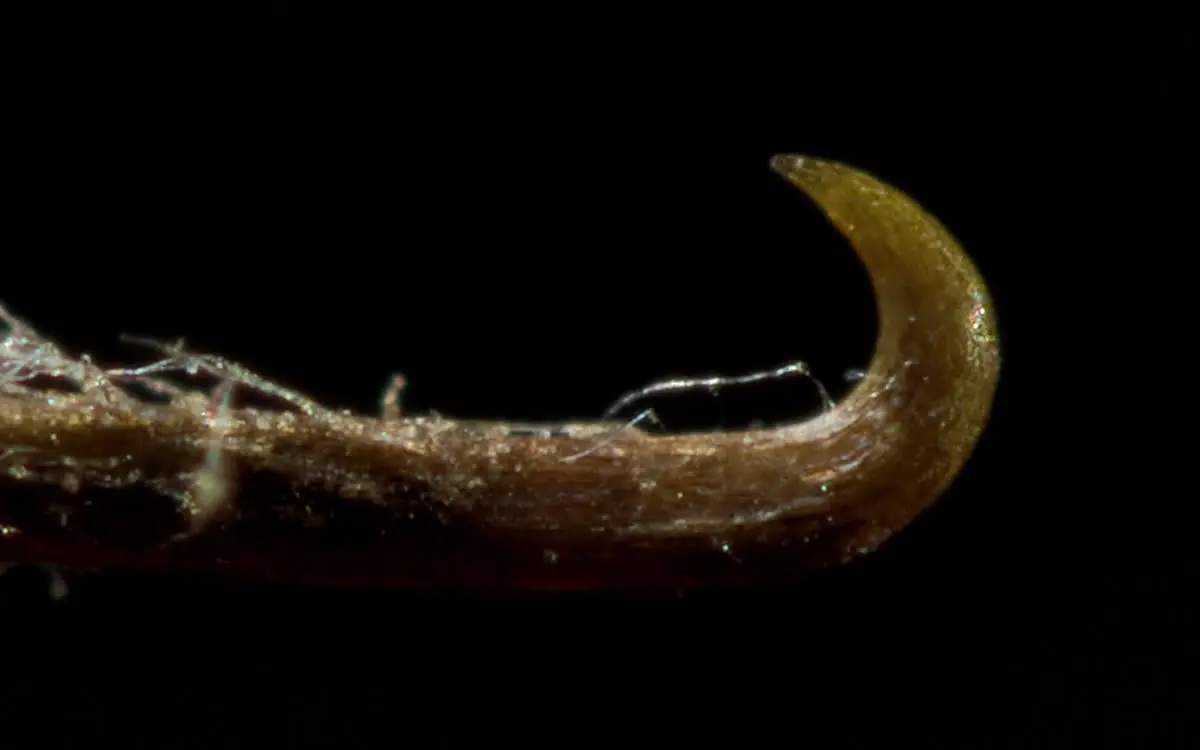
Burdock is an ordinary roadside weed across Europe and Asia. Its genius is in the seed head: the burr, a round cluster armed with dozens of stiff, springy bracts, each ending in a tiny backward-curving hook.
That hook is not decoration. It is a dispersal machine. A plant rooted in one spot has a hard problem - how do you send your children somewhere new? Burdock's answer is to hitchhike. The burr is built to grab the fur of any passing animal, ride along, and drop its seeds kilometres away. The hooks that ruined de Mestral's trousers were doing to him exactly what evolution designed them to do to a deer or a dog: catch, hold, travel, release. His "problem" was not a flaw in the world - it was a finished, field-tested design working perfectly. The only new thing in the story is that someone finally looked at it as a design instead of a nuisance.
The mechanism
Why does a burr stick to a sock but pull free from your hand?
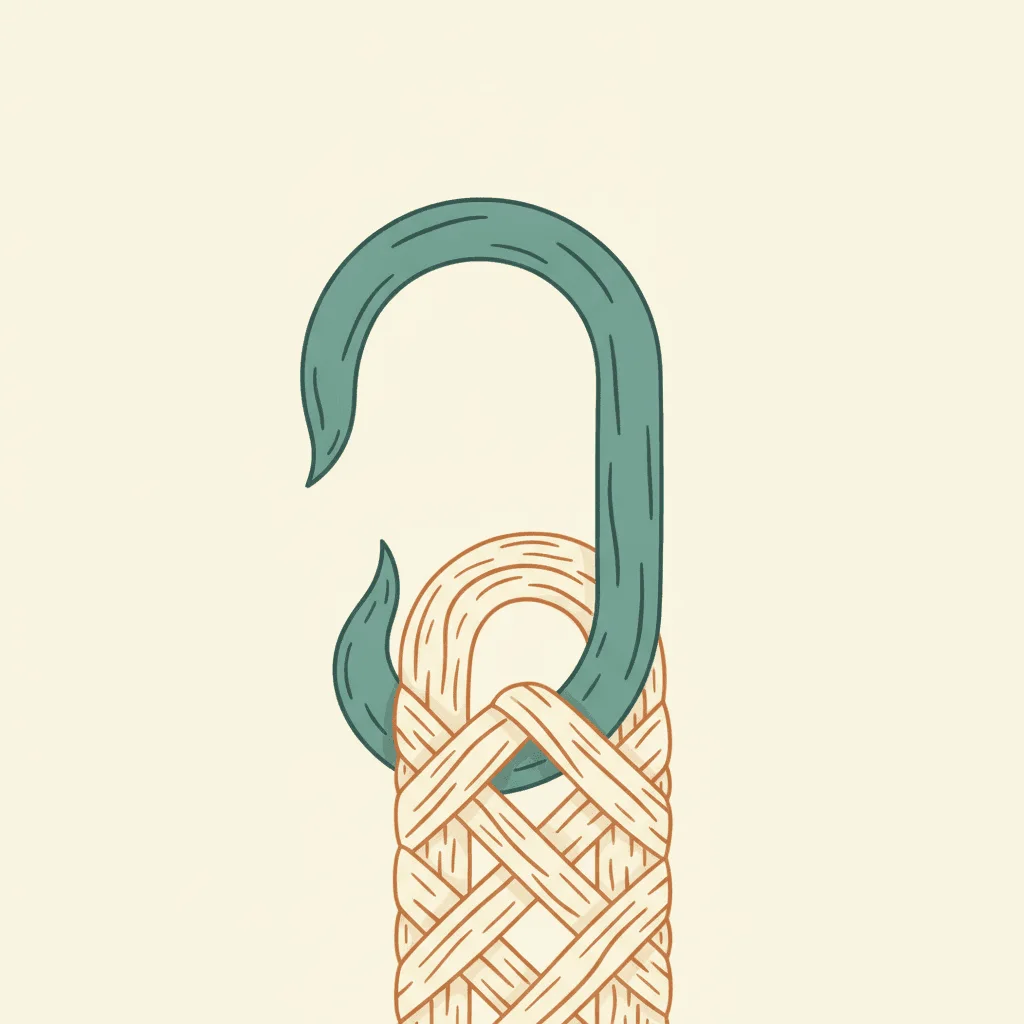
Look at one under a microscope, which is exactly what de Mestral did. Each bract ends in a hook - a hard, curved barb. Fabric, fur and hair are full of loops - soft strands that bend into little arches. When a hook meets a loop, it slips inside the arch and catches. One hook-and-loop pair is trivially weak. But a burr has "hundreds of hooks that caught on anything with a loop, such as clothing, animal fur, or hair," and a coat has thousands of loops - so hundreds of tiny catches happen at once.
The elegance is in the directionality. Pull the two surfaces apart flat - a shear pull - and all those hooks resist together, so the joint feels strong. But peel it from one edge and you defeat the hooks a few at a time, so it lets go easily and without damage. Strong when you want it to hold, weak when you want it off: a reversible, passive, self-fastening joint with no glue, no knot, no moving parts.
De Mestral's leap was to build this on purpose. Cotton prototypes worked but wore out, so he switched to nylon - then a new synthetic - which could be formed into hooks stiff enough to hold yet flexible enough to peel free. One woven strip of hooks, one woven strip of loops. The name came from the two French words for what he had built: velours (velvet) + crochet (hook) = VELCRO. Nature wrote the mechanism in bracts and fur; de Mestral rewrote it in nylon. Same idea, new materials - which is the whole game.
The principle
At the surface there is a physical principle, and it is a good one: many small, reversible catches beat one big permanent bond. Distribute a hold across hundreds of weak, directional connections and you get a joint that is strong under load, gentle to release, and reusable forever - no adhesive, no fatigue-prone hinge, no wear-out.
But this Blueprint carries a deeper principle - the reason it sits at the centre of the library rather than the edge: innovation is not a flash of genius; it is a repeatable act of attention. De Mestral did not invent hook-and-loop - burdock did, over deep evolutionary time. What he supplied was a method: (1) notice something everyone else brushes off, (2) stay curious enough to ask "how does that actually work?", (3) look closer - literally, under a microscope, (4) translate the mechanism into your own materials. Genius is rare and cannot be scheduled. This method can be practised by anyone, on purpose, every day. That is what makes it a blueprint and not just a nice story.
The application
The obvious application is Velcro itself. De Mestral filed his Swiss patent in 1951; it was granted in 1955, and his US patent, No. 2,717,437, "Velvet type fabric and method of producing same," issued on 13 September 1955. From there hook-and-loop spread into footwear and apparel, medicine (cuffs, braces, surgical drapes), and famously into aerospace, holding equipment in the cabins of aircraft and spacecraft. Not bad for a weed.
But the real application of this Blueprint is the method - and this is where The Wild Blueprint lives. Strip out the luck and look at what actually happened:
- Notice the annoyance. The burr was not hidden in a lab. It was a nuisance on a sock - the kind of thing everyone experiences and nobody examines. The raw material of innovation is usually already touching you; the scarce act is paying attention to it.
- Curiosity was already a habit. De Mestral had patented a toy aeroplane at age twelve and trained as an engineer. He didn't get lucky once - he was in the habit of asking how things work, so when the burr showed up, he was ready to see it as a mechanism.
- The gap between idea and product is patience, not brilliance. The 1941 insight took a minute. Turning it into a manufacturable material took, by most accounts, roughly a decade of dogged mechanical trial and error. Attention starts the fire; persistence keeps it lit.
That four-step loop - notice → ask "how?" → look closer → translate - is exactly the pipeline every Blueprint in this library runs. The organisms change; the method does not. Nature is a research programme billions of years long, its results lying in plain sight, already peer-reviewed by survival. You do not need to be a genius to read them. You need to notice, stay curious, and translate - and that is a skill that can be trained.
The takeaway
The burr did not just give us a fastener. It taught us how to look.
Every problem you are cursing at right now - the thing stuck to your sock - may be a solved design waiting for someone curious enough to ask how are you doing that? The people we call inventors are mostly the ones who didn't pick the burr off and walk on. They stopped, looked closer, and translated. That is why The Wild Blueprint exists: to make that act of attention a habit instead of an accident. Nature has already done the R&D. The job - ours and yours - is to keep noticing.
Sources
- Wikipedia - "George de Mestral": 1941 idea after a walk with his dog; burrs identified as burdock; examined under a microscope; "hundreds of hooks that caught on anything with a loop"; toy-aeroplane patent at age 12; Swiss patent filed 1951, granted 1955; name from velours + crochet. https://en.wikipedia.org/wiki/George_de_Mestral
- National Inventors Hall of Fame - "A Walk in the Woods" (1941 idea; cotton wore out, switched to nylon). https://www.invent.org/blog/inventors/walk-in-the-woods-velcro
- US patent record - No. 2,717,437, "Velvet type fabric and method of producing same," issued 13 September 1955. https://suiter.com/patent-history-velvet-type-fabric-and-method-of-producing-same/
- HISTORY - "Who Invented Velcro?" (walk in the woods; burrs on his clothing and his dog's fur; hooks catching looped threads). https://www.history.com/articles/velcro-invention