STRUCTURE/TWB-BP-0005
The Fist That Never Breaks
A finger-length shrimp throws one of the fastest strikes in nature, thousands of times, without shattering its own club - and the secret is a shape hidden inside the material
Independently checked - curatorial review pending
Toughness is often an architecture problem, not a material one - arrange the internal structure so every crack must spiral the long way around and spend its energy before it can split the part.
The problem
A shrimp the length of your finger throws one of the fastest strikes in the animal kingdom - hard enough to crack aquarium glass and split a crab's shell - thousands of times, without breaking its own club. Any engineer knows the real puzzle isn't the punch. It's that the fist survives. The answer isn't a harder material. It's a shape hidden inside the material - and it is now being copied into body armour and sports helmets.
The organism
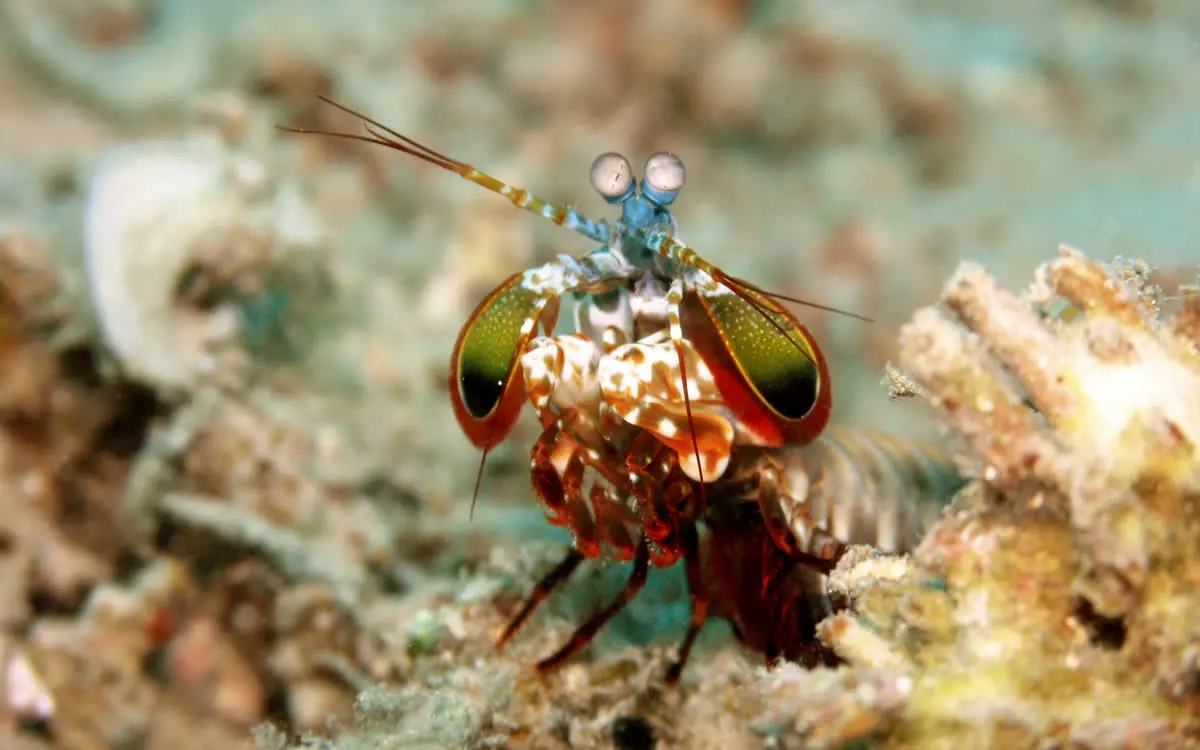
The peacock mantis shrimp (Odontodactylus scyllarus) is a reef crustacean with a pair of spring-loaded dactyl clubs. It stores energy in a latch-and-spring mechanism and releases it to smash hard-shelled prey. The strike is so fast it can even boil a tiny bubble of water - cavitation - that adds a second hit. The engineering marvel is durability: the club takes a punishing number of high-impact blows over the animal's life without failing.
The mechanism
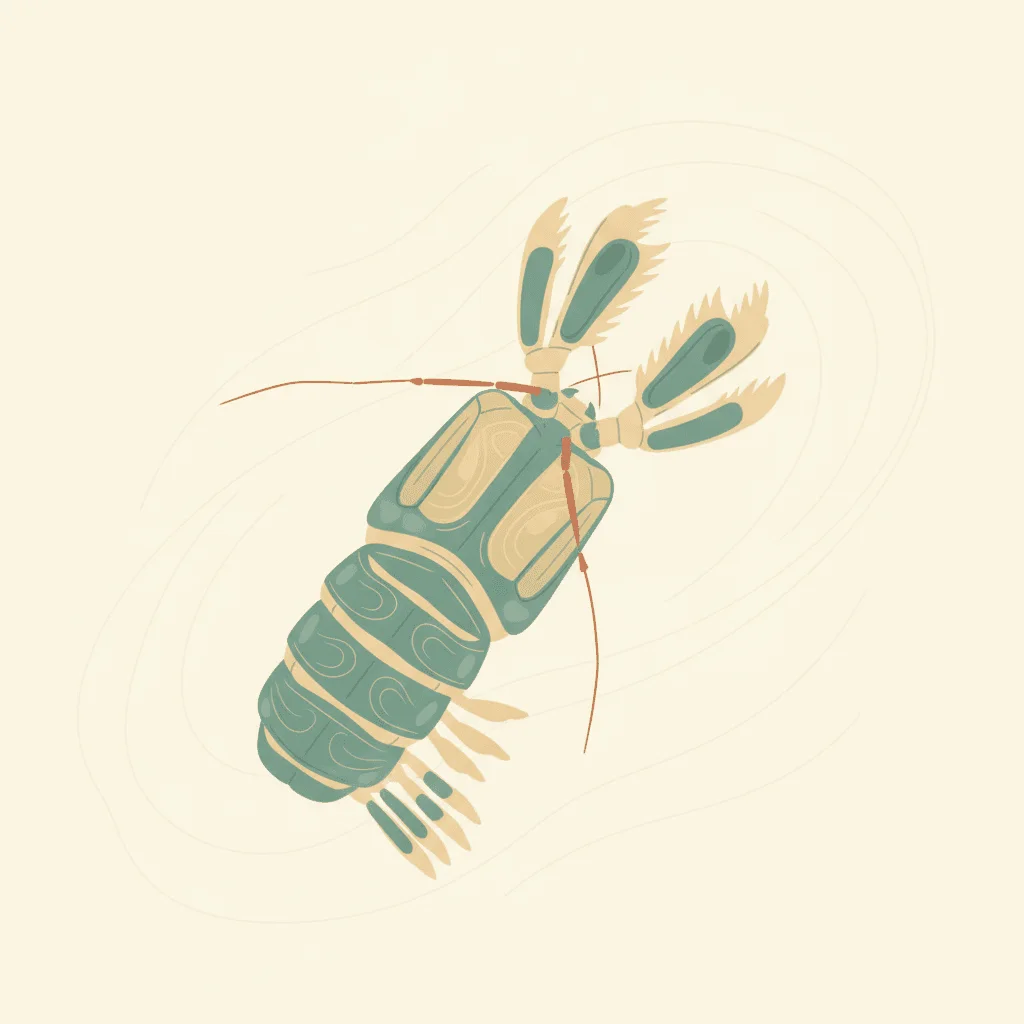
Inside the club's impact region, mineralised fibres are stacked in layers, each rotated slightly from the one below - so the fibre direction sweeps around like a spiral staircase. This is called a Bouligand (helicoidal) structure.
Why it matters: when a crack tries to run through the material, it can't go straight. To follow the weakest path it has to twist and spiral along with the rotating fibres, taking a far longer, tortuous route. A longer crack path means the impact energy gets spread out and absorbed instead of concentrating into one clean split. The material fails gracefully and locally rather than shattering. The hardness of the outer surface matters too - but the twist is what stops catastrophe.
The principle
Beat a brittle-failure problem with geometry, not just hardness. Arrange the internal structure so any crack must travel a long, twisting path and spend its energy before it can split the whole part. Toughness - resisting fracture - is often an architecture problem, not only a material one. It is a sibling of the "shape over force" idea in the kingfisher Blueprint: the win is in the geometry, not in brute strength.
The application
Researchers - notably David Kisailus and colleagues at UC Riverside - reverse-engineered the club's helicoidal architecture and built fibre composites with the same twisting layup. In tests, these Bouligand-inspired composites absorb impact and resist internal cracking better than conventional straight-ply layups. Reported directions include body armour and a football-helmet design; the team has spun the work into a company (Nature Inspired Industries), and a prototype helmet exists.
Honest status matters here. This is a real, funded research bridge with prototypes - not yet a mass-market shelf product like Velcro or the Shinkansen nose. The science is solid and the direction is commercial, but it is early. Saying so is the point: the principle is proven in the lab and in prototypes, and that is already remarkable.
The takeaway
When something keeps cracking under impact, stop hunting for a harder material and redesign the internal geometry: make every crack take the long way around. Twist beats brute strength.
Sources
- Wikipedia - "Mantis shrimp" (dactyl club, strike, cavitation). https://en.wikipedia.org/wiki/Mantis_shrimp
- Wikipedia - "Bouligand structure" (helicoidal architecture; crack-twisting toughening). https://en.wikipedia.org/wiki/Bouligand_structure
- University of California - "Mantis shrimp inspires body armor and football helmet design" (Kisailus, UC Riverside; the applications). https://www.universityofcalifornia.edu/news/mantis-shrimp-inspires-body-armor-and-football-helmet-design
- phys.org - "Bio-inspired technology poised to disrupt the composites industry" (spin-off company; prototype; maturity). https://phys.org/news/2019-08-bio-inspired-technology-poised-disrupt-composites.html