SYSTEM/TWB-BP-0006
The Colony With No Boss
No ant is in charge, none can see the whole map, yet the colony reliably finds the shortest path - and the same idea now helps route network traffic and delivery trucks
Human-curated
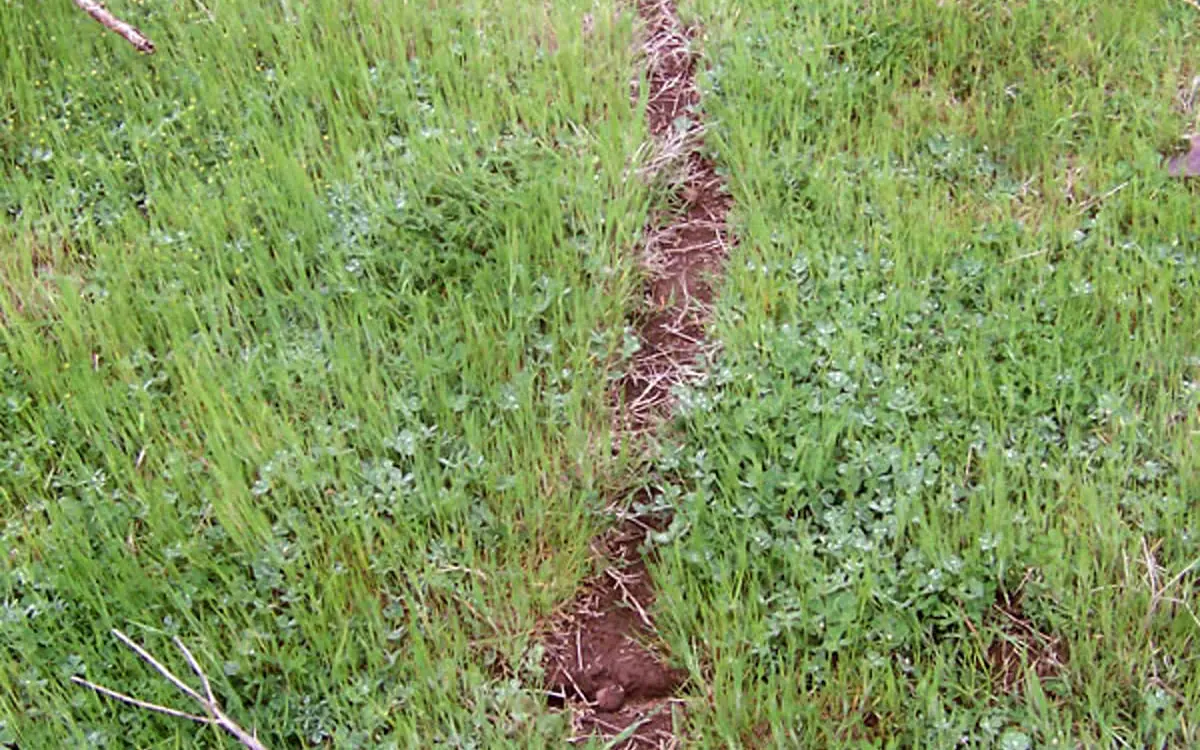
Global efficiency can emerge from many simple agents that leave traces in a shared environment, reinforce what works, and let old traces fade - with no leader and no global map.
The problem
Here is a management problem that should be impossible.
You have thousands of workers. None of them is in charge. None can see more than a few centimetres ahead. Not one of them knows where the goal is when the day starts, and they have no map, no meeting, no memo. Your task: get this crowd to reliably find a very short route between two points - and re-find it when the world changes.
Any human organisation would reach for a manager, a map and a plan. A colony of ants solves it with none of the three. And the same core idea has been turned into working software that helps route packets across networks and plan fleets of delivery trucks. The lesson is not about ants. It is that you do not need a boss or a global view to solve a global problem - you need the right kind of trace.
The organism
Foraging ants - the classic experiments use the Argentine ant (Linepithema humile).
An ant's toolkit is almost insultingly simple: walk, more or less at random; drop a chemical pheromone as you go; and tend to steer toward stronger pheromone. That is the whole repertoire. There is no leader issuing orders, no ant holding a plan, no shared picture of where the nest and the food sit relative to each other.
What makes this worth a Blueprint is that the simplicity is not a limitation to be overcome - it is the source of the power. Because each ant follows the same cheap local rule, you can add thousands of them and the system gets more robust, not more confused. Nothing has to be coordinated from the top, so nothing at the top can become a bottleneck or a single point of failure. The intelligence is not in any ant. It is in the interaction.
The mechanism
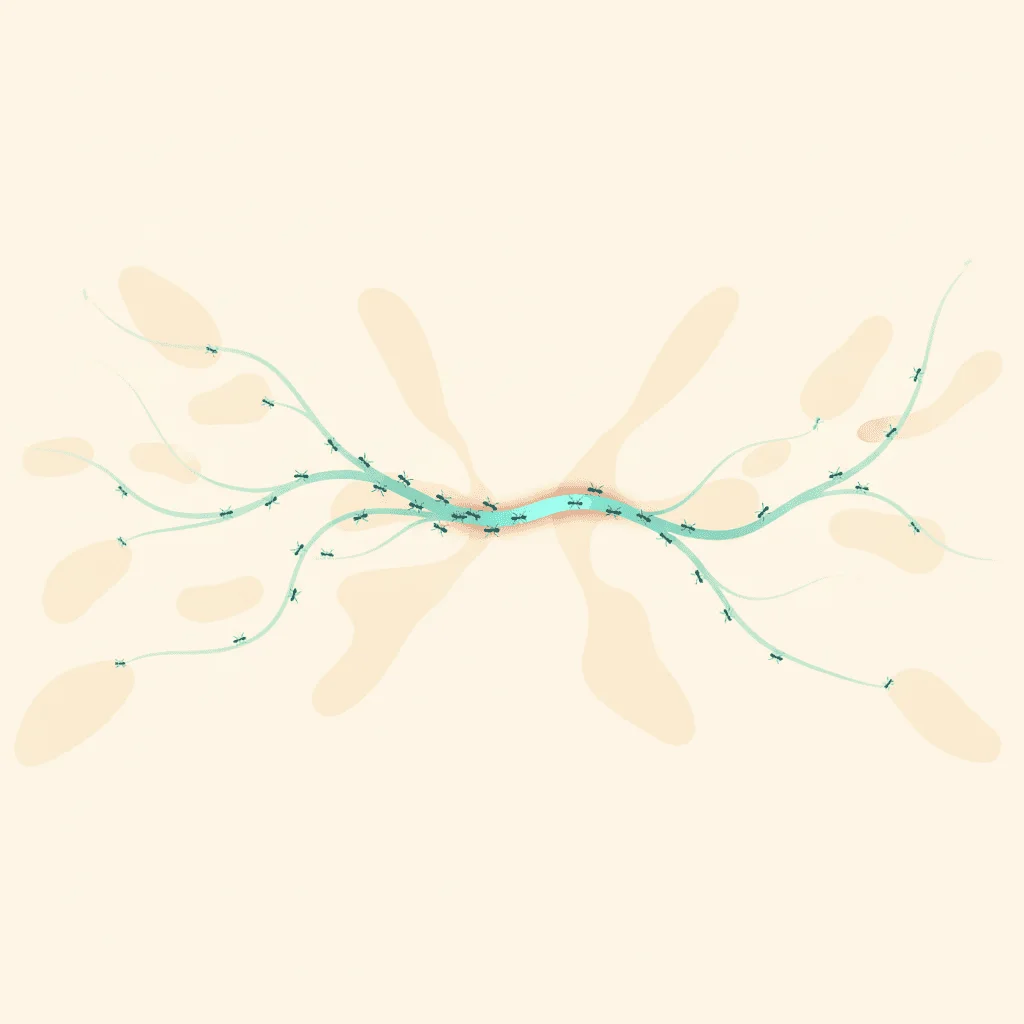
Picture two routes between nest and food: one short, one long. At the start, ants wander onto both more or less equally. Now watch what time does.
An ant on the short route completes its round trip sooner. So in any given window, the short route gets walked more times, and therefore painted with pheromone faster. A slightly stronger trail attracts slightly more ants, who lay down still more pheromone - a positive feedback loop that quickly tips the whole colony onto the short path. No ant ever measured a distance or compared the two routes. The shorter route simply accumulates evidence faster because it can be traversed faster, and the feedback loop amplifies that head start into a decision.
Two more details turn a lucky trick into a robust algorithm:
- Evaporation. Pheromone decays. This looks like a flaw - you are erasing your own hard-won information - but it is the key to adaptability. Stale and dead-end trails fade, so the colony never locks permanently onto the first route it happened to find. When a shortcut opens or a path is blocked, the old trail evaporates and the colony re-converges on the new best route. Forgetting is a feature.
- Stigmergy. For finding the route, the ants pass no direct message to each other - no ant tells another where the food is. They coordinate only by changing a shared environment (laying scent) and reacting to it (following scent). (Real ants do communicate in other ways - by touch, by exchanging food - but the route-finding runs purely on this indirect channel.) Biologists call this stigmergy - indirect coordination through traces left in the world. It is why the system needs no language, no leader and no map: the environment itself is the shared memory.
This was pinned down in a famous, elegant experiment. In 1989 Deneubourg, Goss and colleagues gave a colony of Argentine ants a "double bridge" - two branches to the same food, one longer than the other. With nothing but the rules above, the colony reliably converged on the shorter branch. Symmetry (an equal-length bridge) still gets broken: the colony picks one branch and commits, because the feedback loop amplifies whichever tiny random lead appears first.
The principle
Global efficiency can emerge from simple local agents that (a) communicate only by leaving traces in a shared environment, (b) reinforce what works, and (c) let old traces decay - with no leader and no global map.
The instinct this overturns is "a hard, changing, large-scale problem needs a smarter central planner." Sometimes the opposite is true: a central planner is a bottleneck, a single point of failure, and a thing that must be told when the world changes. The ant approach replaces the smart centre with many dumb edges and one shared, decaying signal. When the problem is too big or too fast-moving for one brain to hold, don't build a better brain - build many simple agents and a trace they can strengthen and forget.
The application
Ant Colony Optimization (ACO).
In the early 1990s Marco Dorigo turned the foraging rule into a family of algorithms (inspired directly by Jean-Louis Deneubourg's work on the real ants). In ACO, artificial "ants" build candidate solutions to a problem, deposit virtual pheromone in proportion to how good their solution is, and let it evaporate over successive rounds. Good partial solutions get reinforced; bad ones fade; the population converges on strong answers - the double-bridge, rewritten in code.
Where it actually gets used:
- Network routing. AntNet (Di Caro & Dorigo) applied ACO to building and maintaining routing tables in packet-switched networks; Schoonderwoerd and colleagues published an ant-based approach for telecommunication networks in 1997. Routes that carry traffic well get reinforced; congested ones fade - a live map with no central controller.
- Vehicle routing and scheduling. Gambardella, Taillard and Agazzi applied a multi-ant-colony system to vehicle routing with time windows in 1999; ACO is used on classic combinatorial problems like the travelling salesman and on wireless-sensor-network routing.
The honest maturity read - because this is where most retellings oversell. ACO is a genuinely used metaheuristic in research and in some industrial routing and scheduling. It is not a dominant industry standard; it is one good tool among several (alongside things like genetic algorithms and modern solvers), and for many problems other methods win. Saying that plainly is the point of this library. The claim that survives is the one that matters: a foraging rule with no leader and no map became working optimisation software - and it did so precisely because the decentralised idea was sound, not because ants beat every algorithm.
The takeaway
When a problem is too big or too fast-changing for one central brain, copy the ants: many simple agents, plus a shared signal that strengthens with success and fades with time. Decentralise, reinforce, forget. It is how a crowd with no boss and no map routes traffic, plans trucks - and reliably finds the short way when nobody can see the whole path.
Sources
- Wikipedia - "Ant colony optimization algorithms": Dorigo's Ant System; Deneubourg's inspiration; AntNet for network routing; Schoonderwoerd (telecom, 1997); Gambardella/Taillard/Agazzi (vehicle routing with time windows, 1999); applications to TSP, routing, scheduling. https://en.wikipedia.org/wiki/Ant_colony_optimization_algorithms
- Goss, S., Aron, S., Deneubourg, J.-L. & Pasteels, J. M., "Self-organized shortcuts in the Argentine ant," Naturwissenschaften 76:579-581, 1989 - the double-bridge experiment: colony converges on the shorter branch via pheromone feedback. https://link.springer.com/article/10.1007/BF00462870
- Wikipedia - "Stigmergy": indirect coordination through traces left in a shared environment. https://en.wikipedia.org/wiki/Stigmergy
Conservation note: the Argentine ant (Linepithema humile) is, ironically, one of the world's most successful invasive species - not remotely at risk. But the broader library it belongs to is: the point of decoding these designs is to read them while their originators are still here, because every extinction is a deleted patent.