INTERFACE/TWB-BP-0010
The Glue That Works Underwater
Almost every glue fails the moment things get wet - water sneaks between the glue and the surface. A mussel solved underwater sticking with one clever chemical trick, and it now coats medical implants and helps seal wounds.
Human-curated
To bond in the wet, first defeat the water layer - a catechol chemistry that displaces water and grips almost any surface is how the mussel does what our glues can't.
The problem
Try to glue two things together underwater and you will almost certainly fail. It is not that our adhesives are weak - it is that water gets in the way. A thin film of water clings to every surface, and glue that cannot push that film aside ends up bonding to water instead of to the thing you wanted. Wet skin, a bleeding wound, a ship's hull, a tooth in a mouth full of saliva: all the same problem.
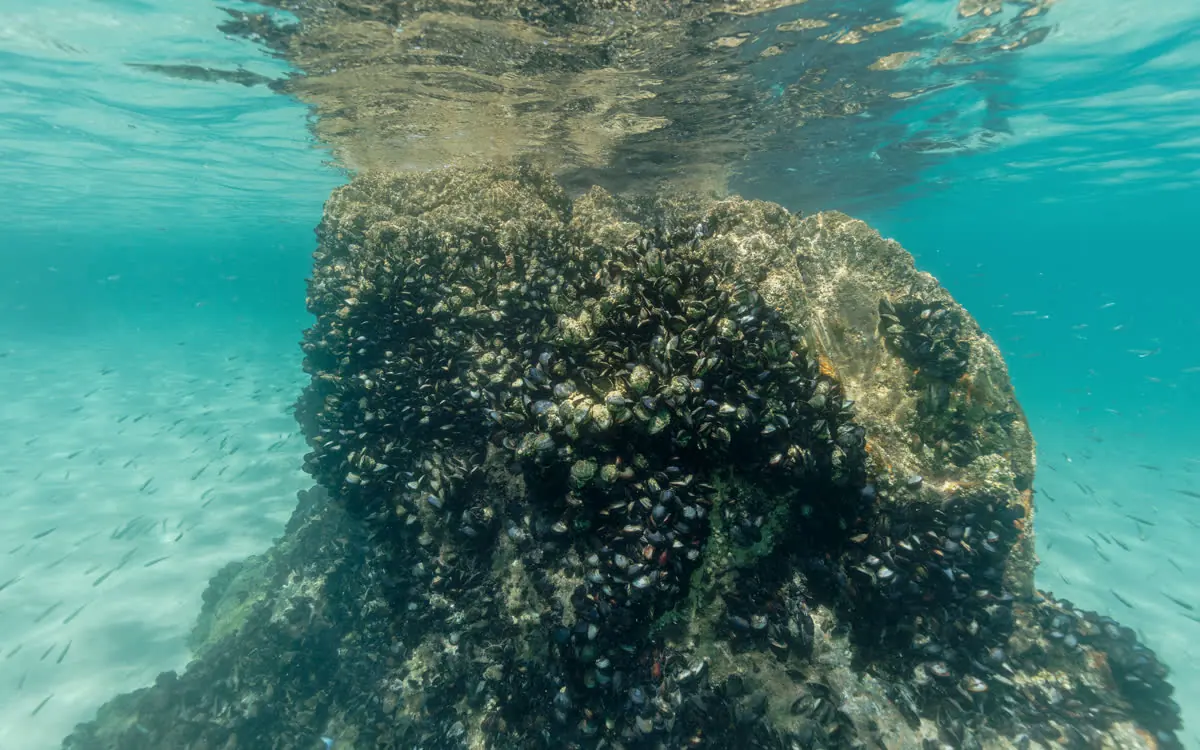
A mussel does not have this problem. It clamps onto a rock in the pounding, salty, permanently wet surf and holds - through storms that throw the entire weight of the ocean at it. It attaches in seconds, underwater, to rock, wood, metal, glass, even Teflon. We spent a long time failing at exactly this before someone asked how the mussel does it. The answer turned out to be a single amino acid - and it is now used to coat surgical implants and stick tissue back together.
The organism
Marine mussels (Mytilus and relatives) - and their byssus.
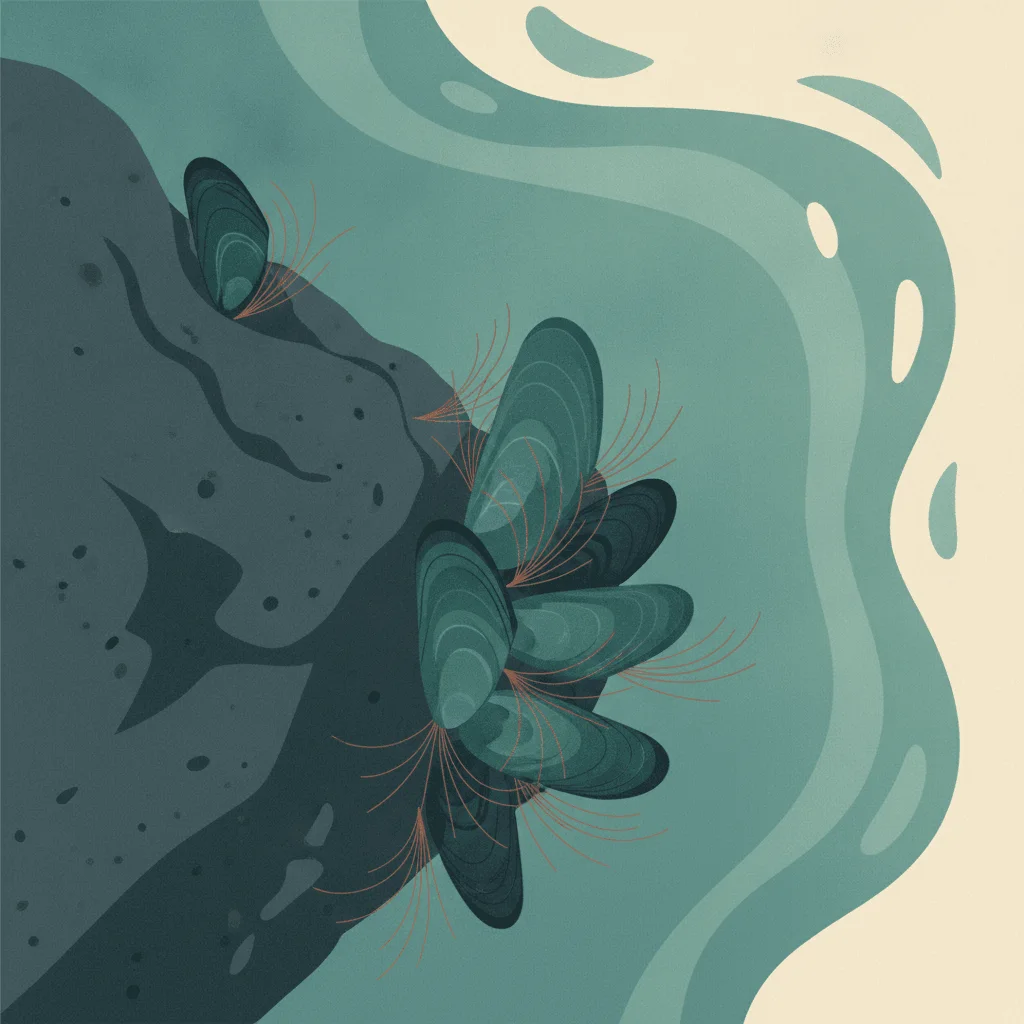
A mussel anchors itself with a beard of tough threads called the byssus. To make one, it presses its soft foot against a surface, squeezes a liquid protein into a groove, and within seconds that liquid sets into a thread ending in a flat plaque - the little disc that actually grips the rock. The mussel can lay down dozens of these, repositioning like a climber setting anchors.
The trick is entirely in the chemistry of those proteins, the mussel foot proteins. They are unusually rich in an odd, modified amino acid: DOPA (L-3,4-dihydroxyphenylalanine), which carries a chemical group called a catechol. That catechol is the whole secret. The mussel did not evolve a stronger glue; it evolved a glue that knows how to get underneath the water first.
The mechanism
Why does catechol stick where our glues slip?
Two reasons, and both matter. First, it displaces water. The catechol group can shoulder the clinging water film aside and make direct contact with the surface underneath - the step most adhesives never manage in the wet. Second, once it is in contact, it is extraordinarily versatile about how it bonds: catechol can grab a surface through hydrogen bonds, coordinate to metal atoms, form strong covalent links, and stack against other molecules. It is not one bond doing the work; it is a whole toolkit, which is why the same chemistry grips rock, metal, glass and even notoriously non-stick Teflon.
There is a second act. When catechols are exposed to the mild oxidising conditions of seawater, some of them convert to a related form (a quinone) that cross-links the proteins together, curing the soft liquid into a tough, set solid. So the mussel gets both halves of a good adhesive: first wet the surface and grip it (adhesion), then harden the glue itself (cohesion). Copy only the sticky molecule and you get tack but no strength; the mussel does both, in seconds, in cold salt water, with no clamps and no drying time.
The principle
To bond in the wet, first defeat the water layer - then bond, and cure.
The instinct that fails is to reach for a stronger glue. But underwater the enemy is not weakness, it is the water film sitting between your adhesive and the surface. The mussel's lesson is that the hard part of wet adhesion is the interface, not the bulk: solve "get through the water and make direct contact" and the rest follows. And the way it solves it is worth stealing on its own - a single chemical group (catechol) that is deliberately promiscuous, able to bond many ways to many materials, rather than one bond tuned to one surface. Versatility beats specialisation when you do not get to choose what you are sticking to.
The application
Catechol chemistry, borrowed wholesale.
Once researchers identified DOPA as the active ingredient, they did something clever: instead of harvesting mussel protein (hopeless at scale), they bolted the catechol group onto ordinary synthetic polymers, giving those polymers the mussel's wet-stick behaviour. The field this opened is large and genuinely productive:
- Mussel-inspired coatings. Dipping almost any object into a solution of dopamine forms a thin, adherent "polydopamine" film on it - a now-standard laboratory trick to make surfaces that other things can grip, used on implants, membranes and particles.
- Medical adhesives and sealants. Catechol-functionalised materials are being developed to close wounds and seal tissue where ordinary glues fail because the field is wet and moving; mussel-derived adhesion is attractive here partly because it is non-toxic to tissue.
Honest status. This is a real, active bridge with deployed coatings and a stream of medical products in development - but a mussel-grade "surgical superglue" that routinely replaces stitches is not yet everyday clinical kit. The coatings are here; the strongest surgical adhesives are still maturing. As with spider silk, copying the chemistry proved far easier than matching everything the animal does with it - but here the copy already works well enough to be useful, which is why catechol adhesion is one of biomimicry's quieter successes.
The takeaway
When something won't stick because the conditions are hostile - wet, moving, contaminated - stop hunting for a stronger bond and look at the interface. The mussel doesn't out-muscle the ocean; it gets under the water first with a promiscuous little chemical group, then cures. If your glue, your coating, or even your message isn't holding, ask what thin film is sitting between you and the surface - and how to displace it before you try to bond.
Sources
- "Mussel-Inspired Adhesives and Coatings," Annual Review of Materials Research / NIH-PMC review - mussel foot proteins, DOPA/catechol as the key to wet adhesion, oxidative cross-linking, and the range of biomimetic coatings and adhesives derived from it. https://pmc.ncbi.nlm.nih.gov/articles/PMC3207216/
- "Mussel-Inspired Bioadhesives in Healthcare," NIH-PMC review - catechol bonding mechanisms (hydrogen bonding, metal coordination, covalent cross-linking) and biomedical adhesive applications; low toxicity/immunogenicity. https://pmc.ncbi.nlm.nih.gov/articles/PMC7056592/
- "Molecular design principles of Lysine-DOPA wet adhesion," NIH-PMC - how DOPA/catechol displaces surface-bound water to make direct contact underwater. https://www.ncbi.nlm.nih.gov/pmc/articles/PMC7403305/
Conservation note: marine mussels are widespread and heavily farmed, not a species at risk - but they are sentinels of coastal water quality, and the reefs and shorelines they cling to are under pressure. Every extinction is a deleted patent, and some of those patents are written in chemistry we are only beginning to read.