INTERFACE/TWB-BP-0011
The Surface That Makes Flow Behave
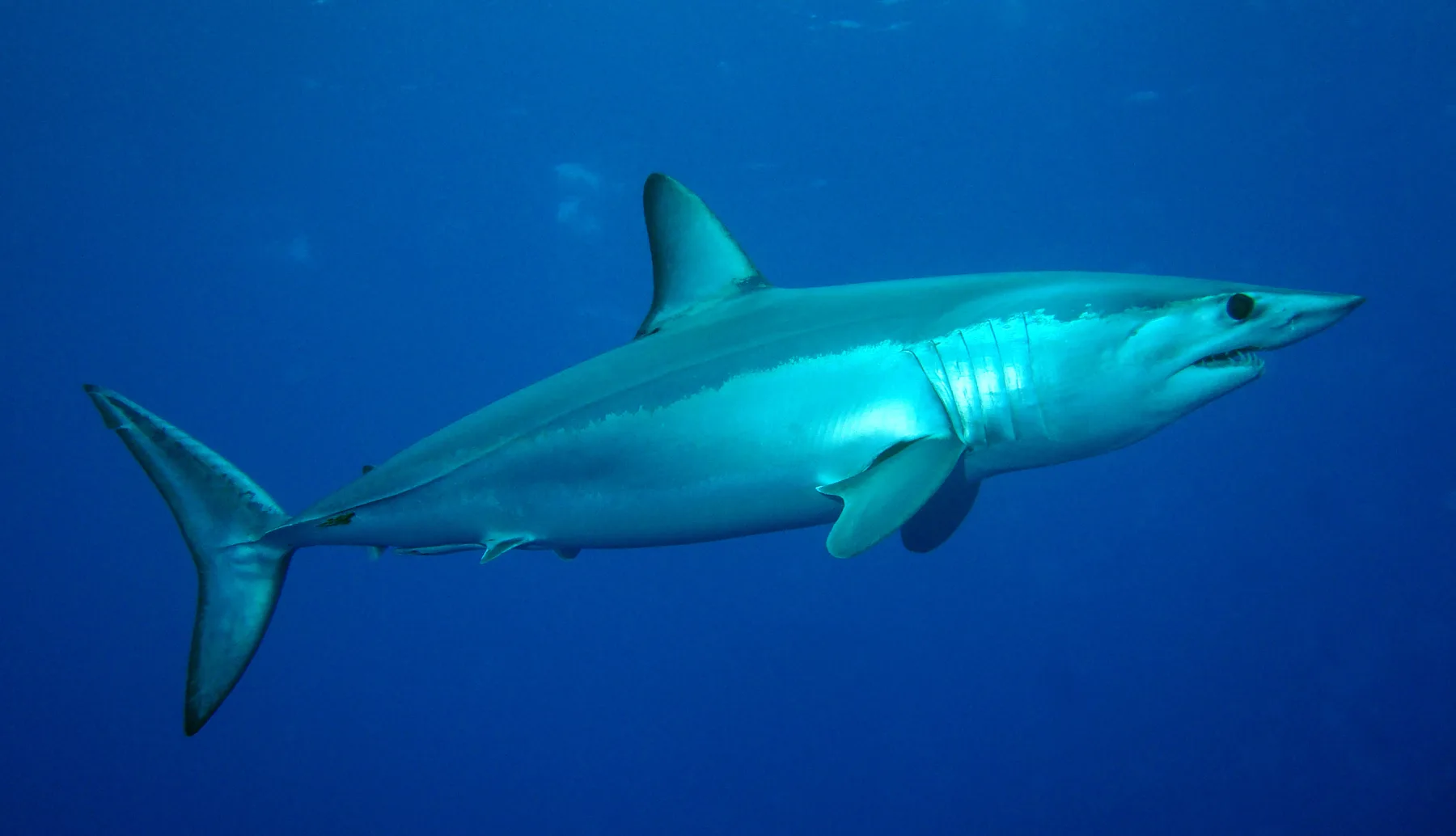
A shortfin mako shark does not wear a smooth wetsuit. Its skin is a field of tiny, directional teeth - and the lesson is not “make it rough,” but make texture answer to the flow.
Independently checked - curatorial review pending
Do not treat a surface as passive skin: directional microgeometry can influence how fluid and would-be colonisers meet it - but copy the function, not a cartoon of the animal.
The problem
Engineers are trained to make a fast surface smooth. Sand a boat hull. Polish a turbine blade. Remove every bump that might trip the flow.
Then there is the shortfin mako shark. Its skin feels like sandpaper when stroked from tail to head, because it is covered in thousands of tiny tooth-like scales. The apparent contradiction made shark skin famous: how can a rough surface belong on one of the ocean's most efficient swimmers?
The lazy answer is that shark skin is a universal drag-reducing coating. It is also wrong. A surface texture can reduce skin friction in one flow regime and add drag in another. Real shark denticles differ across the body; engineered riblets are often only a loose visual cousin. The useful lesson is more demanding: texture works when its shape, direction, scale and local flow are designed together.
The organism
The shortfin mako shark (Isurus oxyrinchus) - and its dermal denticles.
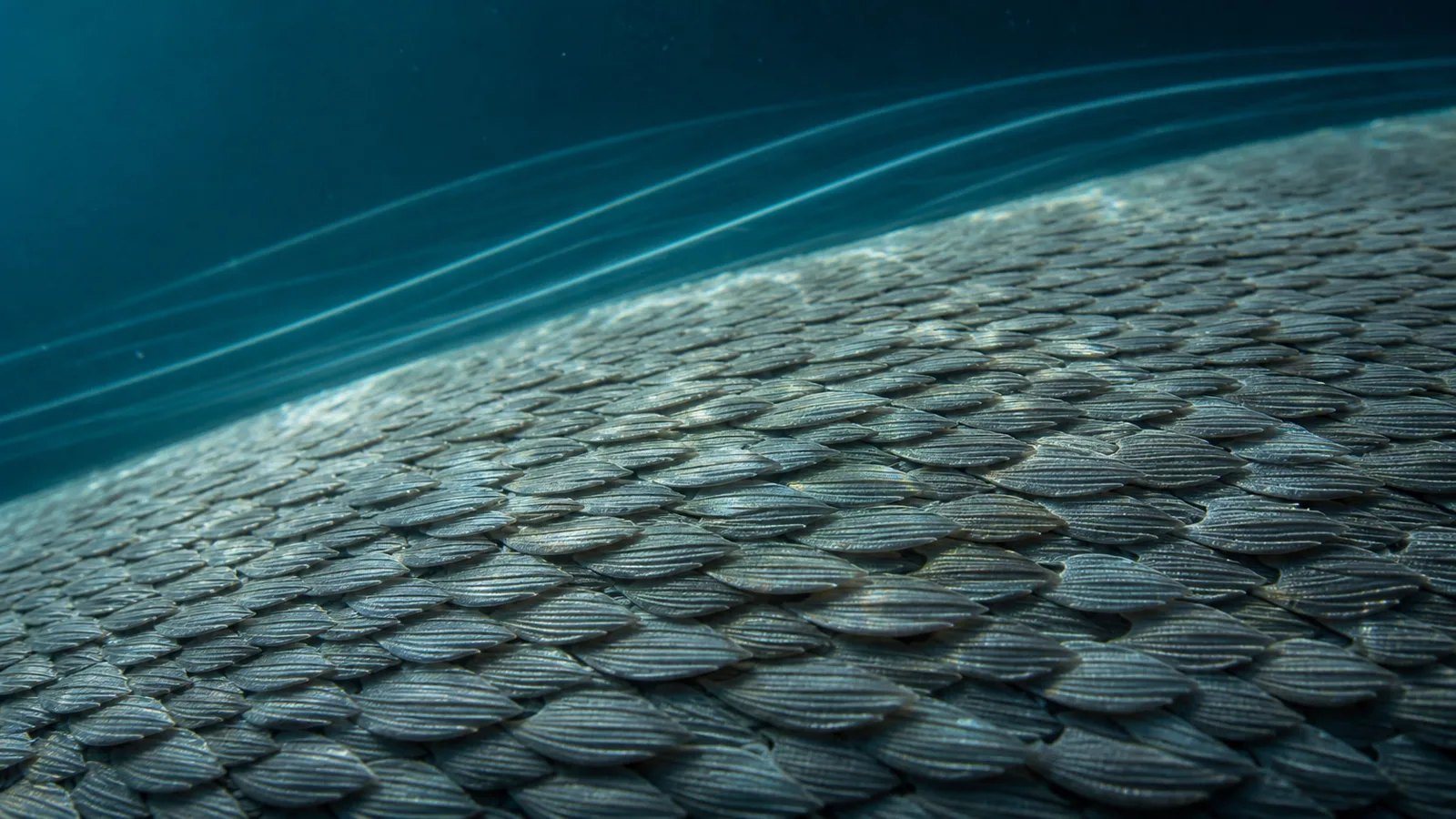
Denticles are not ordinary fish scales. They are hard, tooth-like structures embedded in the skin. On a mako, their form and orientation change from one part of the body to another. Individual denticles carry longitudinal ridges; together they make a directional surface rather than a uniform rough coat.
That variation matters. Studies of shark skin report different denticle geometries by body location and habitat, and work on mako skin shows that the hydrodynamic result changes with denticle shape and angle. The animal is not wearing one uniform pattern everywhere; the precise functional role of each local geometry is still being worked out.
The species also gives the Blueprint its stakes. The IUCN's 2019 global assessment listed the shortfin mako as Endangered; the live Red List record should be checked whenever this text is updated. A fast open-ocean predator is not merely a beautiful reference image for industrial design; it is a living system under pressure whose details we are still learning to read.
The mechanism
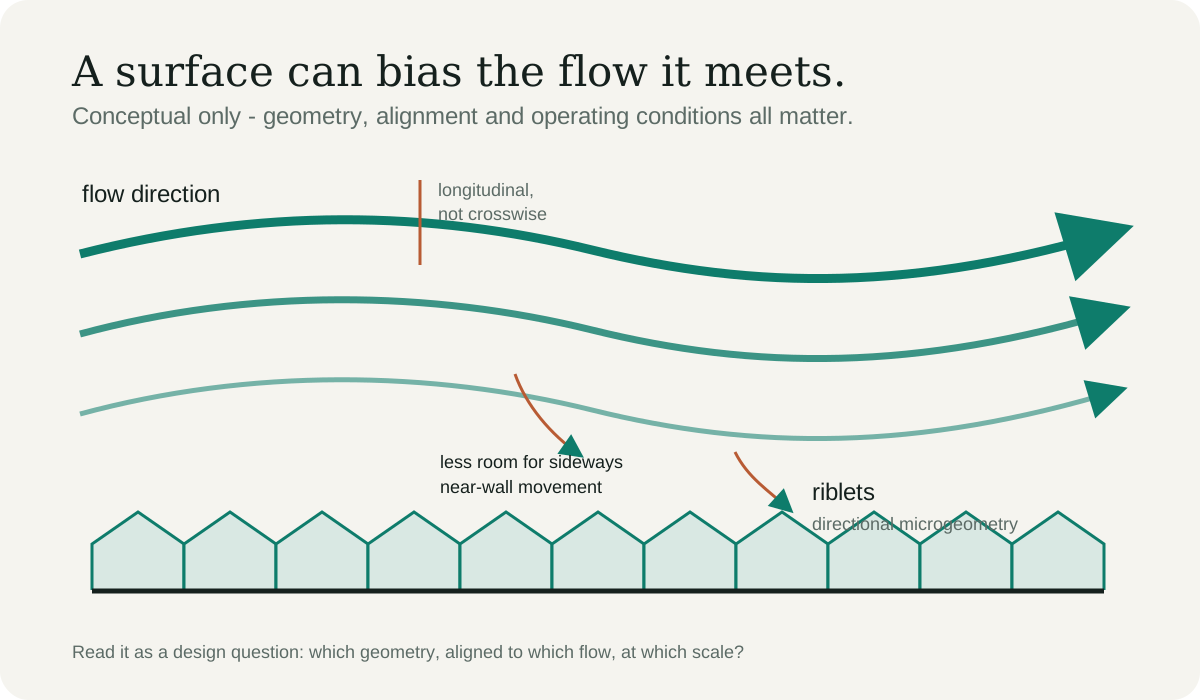
At the wall of a moving fluid sits a boundary layer: a thin region where water slows down because of friction with the surface. In turbulent flow, fluid structures move sideways as well as downstream, exchanging momentum with the wall and raising skin-friction drag.
Longitudinal ridges - riblets - can constrain part of that sideways motion. They do not make friction disappear. When their spacing is appropriate for the boundary layer and aligned with the flow, they can alter near-wall turbulence and may reduce skin friction. Get the scale or angle wrong and the texture becomes a penalty instead.
Shark denticles add more than a row of grooves. Their crowns, ridges, spacing and orientation vary; on a moving shark they are coupled to a flexible, undulating body. That is why a 2022 comparison found engineered riblets to be quantitatively different from real shark skin. “Shark-inspired” is a starting hypothesis, not a performance guarantee.
The same general idea has a second use. Some engineered microtopographies make it harder for microbes to settle and spread, without trying to poison them. Here the objective is not drag reduction but attachment control: geometry changes the physical landscape a cell encounters. It is a related interface problem, not evidence that every denticle pattern is antibacterial.
The principle
A surface is a control system, not a passive boundary.
When drag, fouling or colonisation matters, do not ask only which material to use. Ask what happens in the first micrometres where fluid, organism and surface meet. Directional texture can give that interface a bias: guide flow one way, obstruct sideways motion, or make attachment less favourable.
But biomimicry has a discipline: copy the operating rule, then test it in the real conditions. A mako's denticles are neither a decorative shark pattern nor a universal solution. They are a reminder that “smooth” and “low drag” are not synonyms.
The application
Riblets - and a cautious laboratory lead on bacterial colonisation.
One engineering branch uses riblets. Shark-inspired surfaces have been tested on aerofoils, wind-turbine contexts and hydrodynamic models. Results are conditional: in the 2012 mako study, flexible foils with intact denticles improved swimming performance in the tested setup, while rigid comparisons did not support a universal drag-reduction claim. A rigid riblet panel is not a swimming shark, and faithfully reproducing the three-dimensional detail of biological denticles at relevant scale remains difficult.
The second branch is a laboratory lead on bacterial colonisation, not a settled application. One in-vitro study of Sharklet-patterned silicone samples and rods designed to model a catheter surface reported lower E. coli colonisation and migration than a smooth control without antimicrobial chemicals. All of that study's authors were employees or consultants of Sharklet Technologies, and it did not test a real catheter or a clinical outcome. It is therefore a useful hypothesis for independent replication - not evidence of infection prevention.
The bridge therefore has two maturity levels:
- Flow control: riblets are an engineering family whose performance depends on geometry and operating conditions.
- Bacterial attachment: the cited microstructured-surface result is company-affiliated laboratory evidence; medical outcome claims require independent clinical evidence.
The takeaway
The mako is not fast merely because its skin is rough. Its denticles are one part of a fast animal's directional, local and body-coupled surface system.
That is the transferable design rule: when the interface is the bottleneck, design the interface. And when someone says they copied nature, ask the question that separates a Blueprint from a gimmick: which function, under which conditions, and what did they actually reproduce?
Sources
- Gabler-Smith, M. K. & Lauder, G. V. (2022). “Ridges and riblets: Shark skin surfaces versus biomimetic models.” Frontiers in Marine Science 9:975062. Direct 3D comparison of denticles, engineered riblets and swimsuit materials; documents both the potential and the mismatch between biological and engineered surfaces. https://doi.org/10.3389/fmars.2022.975062
- Oeffner, J. & Lauder, G. V. (2012). “The hydrodynamic function of shark skin and two biomimetic applications.” Journal of Experimental Biology 215, 785-795. Experiments comparing intact and sanded shortfin-mako skin on flexible foils. https://doi.org/10.1242/jeb.063040
- Domel, A. G. et al. (2018). “Shark skin-inspired designs that improve aerodynamic performance.” Journal of the Royal Society Interface 15:20170828. Denticle-inspired vortex-generator designs tested on an aerofoil. https://doi.org/10.1098/rsif.2017.0828
- Reddy, S. T. et al. (2011). “Micropatterned surfaces for reducing the risk of catheter-associated urinary tract infection.” Journal of Endourology 25, 1547-1552. In-vitro evidence for a Sharklet micropattern; no clinical-outcome claim. https://pmc.ncbi.nlm.nih.gov/articles/PMC3168968/
- Fisheries Research and Development Corporation / Status of Australian Fish Stocks (2023). Shortfin Mako, Isurus oxyrinchus - records the 2019 global IUCN assessment as Endangered. Live IUCN record: https://www.iucnredlist.org/species/39341/2903170
- Hero photograph: Patrick Doll, “Kurzflossen-Mako”, 2011, CC BY-SA 3.0, via Wikimedia Commons. The web copy was resized and converted to WebP; its content was not otherwise altered.
- Denticle illustration: original AI-assisted editorial reconstruction, created for The Wild Blueprint; morphology informed by Gabler-Smith & Lauder (2022), above. It is not a micrograph or a measurement.
Conservation note: the shortfin mako is a threatened member of the same ocean library this Blueprint draws from. The point is not that conservation makes a weak engineering story stronger; it is that a strong engineering story makes the loss concrete. Every extinction closes experiments we did not know how to run.